
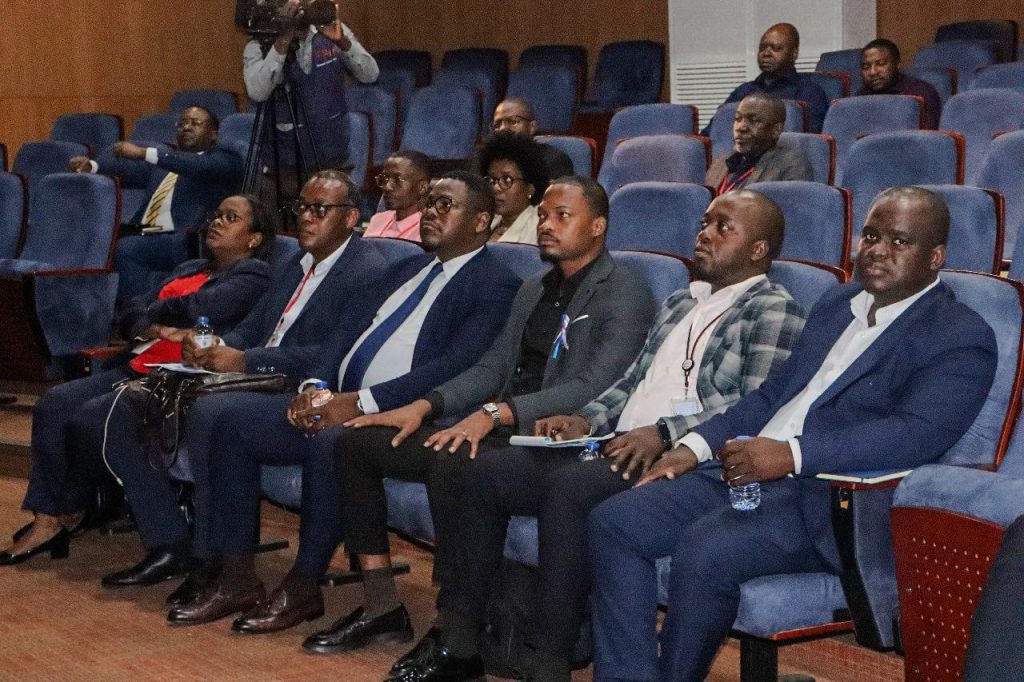
On Monday 27th, in Luanda, the auditorium of the National Statistics Institute (INE) hosted the training workshop on Public-Private Partnerships (PPP) promoted by the Ministry of Planning, an initiative that brought together representatives of public institutions, businesspeople, academics and members of civil society.
Under the slogan “Training on Public-Private Partnerships”, the event was structured in several stages, with the highlight being the debate and clarification sessions spread over four thematic groups: The process of structuring and implementing PPPs – the five phases of a PPP; Presentation of case studies (such as Chipindo, EPAS Cabinda, PDI Cunje and PIR Canjala); and Presentation of the PPP Portal and the SOURCE platform, among other moments that included space for questions and answers.
At the opening of the event, the National Director for Public-Private Partnerships, Wenilton da Paixão, pointed out that the development of the Angolan economy requires new financing models for large infrastructures.
According to the official, “the country faces a clear challenge in the General State Budget, pressured by population growth and the need for higher quality public services. We need to build new infrastructures and, at the same time, guarantee the maintenance and modernization of existing ones,” he said.
Wenilton da Paixão stressed that relying exclusively on the State Budget to finance development is no longer enough, which is why the Ministry of Planning intends to strengthen its role as coordinator and central promoter of PPPs with the aim of increasing the participation of private capital in the economy, guaranteeing efficiency, innovation and sustainability of public assets.
The director added that the Luanda seminar marks a high point in the Ministry’s structuring efforts, with a practical focus on identifying projects in the provincial administrations of Luanda, Kwanza Norte and other regions of the country, in order to make them attractive to private investment.
“Our capital has great potential for investment in sectors such as housing, sanitation, energy and logistics. In the energy sector, for example, projects such as the Quilemba solar plant and mini hydroelectric plants stand out, with the goal of reaching 800 megawatts by 2025,” he said. The leader also pointed out that the financial sector recorded a 20.7% growth in credit to the private sector, reaching 6.9 billion kwanzas in March 2025.
During the event, the role of the Diversifica Mais Project was also highlighted, which has been supporting the development of PPPs in the country, bringing technical rigour, institutionalization of projects and capacity building to the public and private sectors. The project, financed to the tune of around 300 million dollars, aims to directly benefit 12,000 private companies, with a focus on medium and small companies led by women, and to boost the structuring of productive infrastructures along the Lobito Corridor.
The National Director also stressed that the success of public-private partnerships depends first and foremost on the technical capacity of the state. “PPP contracts are complex and long-term. We need technicians capable of rigorously analyzing, negotiating and overseeing these agreements, protecting the national interest and assigning the risk to the party that can best manage it,” he stressed.
Finally, he stressed the importance of technical, economic and environmental feasibility studies as an essential condition for attracting private capital. “Presenting viable and bankable projects is our main guarantee for attracting investment and protecting public assets,” he concluded.
The workshop was attended by entrepreneurs, civil servants, academics and representatives of civil society.